Saturday, May 9, 2009

It's 1pm. Do You Know Where You Are, and What You're Flying?

Yesterday I understood what it must be like to be a full time pilot...hectic! Let me back up a bit and say that I had a LOT of fun however, as I've carved my life into having a part-time job that pays the bills, so I can have more time to do other things I love, like parent, play, teach and fly!


The day started with getting my 7 year old son on his school bus. This involves a well orchestrated routine of snack preparation, homework in bag, scooter ride to the bus stop, chat with other parents, and good bye hugs. After swinging by the office, I met my friend and fellow CFII, Brendan,for our mutual Instrument Competency Checks at Augusta State airport.


My friend has a deal worked out with the owner of a well-equipped Bonanza 36, and I was going to finally learn about the elusive WAAS approaches! We filed and departed Augusta, headed to Bangor with a broken layer at 2000 feet, perfect weather to get some actual while learning power settings, autopilot functions, and the Garmin 430 approaches. After the GPS LPV approach to minimums, we went missed and held as published with the autopilot doing a great job and my brain sucking in as much as it could. This aircraft with all its gizmos is a far cry from the C172 (soon to be switched over to floats) I'm used to flying. I was having a hard time keeping up, but if pushing my mental envelope was what I'd signed up for, I was getting my money's worth!


Once back on the ground in Augusta, we both checked our cellphone messages (am I the only pilot who'd occasionally like to throw it out the window at 6000 feet?) Fortunately I had a message from a friend who deals Cessnas asking if I was available to go to New Bedford to pick up a new Skyhawk that he was demo-ing. After crucnching some quick time schedules in my head, I thought, "This might work." I asked Brendan if he'd like to alter plans. I still had to fly my legs to get my ICC done, but perhaps we could kill two birds with one stone (as opposed to one prop). He heartily agreed. We ran over to a local sandwich shop and grabbed a bite to eat before heading down to Portland in the Bonanza.

My leg from Augusta to Portland was uneventful and with the aid of Brendan's outstanding instruction (and patience) my arrival and landing were pretty smooth. I can see why these airplanes are so popular, and why they're deemed a "pilot's airplane". It was rock solid in the clouds and light bumps and very fun to fly (assuming you follow the numbers).


Once in Portland we met up with my friend and after quickly checking the weather, forecast to be scattered to broken at 4000, we were off VFR to New Bedford in a sturdy Cessna 172 RG. Unfortunately Boston airspace was busier than we thought and rather than being cleared into the Bravo airspace we either were going to have to go over at 7500 or head out over the water and remain 15nm DME outside of BOS. In vain we tried to climb over the crud at 7500. Seeing that that wasn't going to work out, we opted for the 3000' over the water and hoped that the engine ran as smooth as it had to this point (is it me or do all engines run rougher over the water? Or perhaps that's the sound of my gritting teeth.) The arrival into New Bedford was uneventful as we dropped off our friend to return the new Skyhawk while we took off in the RG back to Portland.

Weather in Portland was less than forecast as rain showers and low visibilities were scattered throughout the area. After trying to sneak in VFR, I finally admitted defeat and we ended up getting cleared for the ILS to Runway 11. Again, I was reassured by Brendan's presence and understood the adage of one of my former CFI's- "I'd always rather have a second pilot than a second engine!" (I'd actually like both, but we'll have to wait for Lotto to fulfill that dream!)

Once on the ground in PWM we headed inside to eat a cookie and check the actual weather, not just the optimistic forecast. I was actually beginning to see and feel what the life of a busy charter pilot might look and feel like. We'd seen a lot of airports, lots of approaches, lots of people, and the day still wasn't over! I was scheduled to teach our final ground school class that evening in Waterville and it was clear that getting back to Augusta and hopping in my car was going to leave me really late. But wait, we've a Bonanza sitting right here! You guessed it, Brendan kindly agreed to shuttle me to Waterville and I'd worry about how to get back to my car after class. Taking off from Portland, we stayed west of the "red stuff" (did I mention XM weather?) and had a smooth flight touching down in Waterville at 5:02 pm with private pilot students eager to learn.


I finished class on time and handed out the diplomas, ending with phrases that I'd stored in my own head over the years..."You're not a real pilot until you've taken the bus!" and "The superior pilot uses their superior knowledge to avoid having to use their superior skill!" I suspect we've all got our favorites, but the point was hopefully hit home...don't do anything dumb, this is really just a license to learn.

After class I asked one of the students who'd recently earned his private license to fly me back to Augusta, and he readily agreed. So at 730 pm I literally hobbled my way to my car and went home to pass out in bed.

Much of my life I've spent fantasizing about what it must be like to fly for a living. Sturdy equipment, exotic landing sites, technical avionics that keep us safe amidst mother nature's fury; but at the end of the day, I was probably like a lot of people who had put in a hard day's work...TIRED! But ask me tomorrow if I'd do it again. I bet you'd see a smirk come across my face and I'd think about all those people, airports, and picturesque landscapes and I'd nod, "You bet."

Sunday, March 22, 2009

Why does “ITT” cause so much of a rush?


Today I got to participate in one of those aviation “firsts” that you dream about. You’ll have to read on to find out what “ITT” was…

One of my first recollections of the wonder of aviation was when I took an Air New England flight from Lebanon NH to LaGuardia NY. I was probably just in my double digits age wise (gosh that seems a long time ago) when my mom waved good-bye to me and I climbed into the back of the long silver tube with the high wing and oil stained turboprop nacelles. My seat was under the wing near one of those looming engines, and I can recall how I stared at the landing gear coming out of the bottom of it. I was struck by the size and power of such a structure. There were huge blades emanating from the front of it and as the flight attendant closed the door, the high pitched whine started and soon the blades gathered speed and the whole plane started to shake with energy. Such sounds and energy were new to me, as I’d been dropped off at the airport in an old Subaru. I’d watched these beasts depart from behind the chain linked fence, wondering if perhaps I’d ever get to fly something so massive, and here I was now sitting just feet from those spinning blades as a passenger to “N Y C”. What could be cooler? The plane taxied and soon the engines really came to life, pulling us down the runway with the gear somehow magically disappearing inside the engines and within an hour we were on final approach into LaGuardia over the water and in one of the coolest cities on earth. If this was aviation…I wanted more!

Well today after practicing some spins in a Cessna 150 with another flight instructor, I was given the opportunity to start up a set of Pratt and Whitney’s myself. Uhh, OKAY! I grabbed a pen and paper hoping to glean some facts from the briefing, as I’ve read countless articles on “hot starts”, “ITT”, “torque”, and “low idle”. Now I could experience them up close, as terms like these escape us mere pistons folks!

Walking up to the large nacelles (also streaked with exhaust gas oils by the way), I learned from my friend that these were PT6-27’s which use a starter that then turns into a generator (cool). The air flows into the bottom of the nacelles and does a 180 degree turn up into the compressor where it’s mixed with fuel from 14 nozzles and “fire” from 2 igniters to create…you got it… LOTS OF THRUST! This is a “free turbine” which means that the power plant and propeller are connected by some sort of “clutch-like” mechanism that builds pressure as the turbine spins, eventually moving the propeller unit with it (at much fewer rpms of course). Having checked the oil and making sure everything else looked in place, we closed the nacelles and climbed into the cockpit.

My friend explained the checklist procedures that are used before starting. The dials (of which there are many) that I needed to keep an eye on included the “ITT” gauge and the "% rpm". "ITT" stands for Inter-turbine temperature, and you don’t let it go over 1090 degrees C. In summary the battery is turned on, then the primary boost pump comes on, quickly followed by the right ignition/starter switch. The large feathered prop begins to spin while I hear the familiar high pitched whine coming from the engine compartment (this was going to be neat). I could already feel my pulse increase, thinking “I’m actually going to do this!” Fairly soon thereafter (about 3 revolutions of the now slowly turning propeller) the “% rpm” went over 12 % and we moved the condition lever forward from cutoff to “low idle”. The sound reminded me of the low “woof” heard when you light your gas grill a bit after the propane’s been on, and suddenly the % dial and ITT began to climb. My friend said in all his years he’d never had a “hot start” but this is where your eyes stay glued to the ITT and if it climbs over redline headed to the 1090 C number you’d immediately pull the fuel off. Our temps stabilized near the 500 degree mark with 50% rpms indicated and “Voila!” -I’d done my first turbine start successfully!


The procedure is similar with the second engine and soon both props were whirring with the familiar hum I’d heard from that old Air New England bird. After bringing the props out of feather we checked the gauges and all looked fine. After an easy and uneventful shut down we spent a few more minutes reviewing checklists and other safety features, including dual elevator trim systems, autopilot disconnect, crossfeeds and secondary boost pumps and emergency gear extension systems. Someday soon I’ll probably get to fly one of these turboprop beasts. I’m told to hang onto my hat as climb out is a little different from the Cessna Skyhawks I’m used to commanding. But all planes respond to lift, weight, thrust and drag so I’ll not be too surprised…just aware that some have more thrust from “ITT” than others!


Here's a youtube link to a start up...(more fun when you're in the cockpit!)...
http://www.youtube.com/watch?v=JenaHHKcbZ0&feature=related

Sunday, July 13, 2008

Flying from your backyard

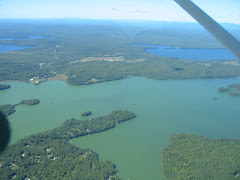
Today I realized one of my recent dreams...I took off from my backyard! Let me back up. I live in Maine, so as a pilot our time to get aloft without clouds or ice is....well limited. So when a warm summer day with 5 knots of breeze comes along, you take advantage of it. But today would be no ordinary flight, I would depart from my own backyard!

We had purchased our old cape a decade ago with hopes of someday taking advantage of the fact that it was on water. Apart from swimming on hot summer days in the lazy river was my dream to someday taxi a float plane up to the dock in our own backyard. The latter goal was always just that-a goal. A fallen oak had other plans, covering half the river with it's bows and limbs but a few hundred yards upstream.
Granted that tree provided many bass for the anglers in it's cool summer shadows, but I had other motives, and secretly wished the currents to come along and sweep it toward the dam downstream of our house. This spring my wish was realized, as I looked upstream as the snow melted and saw no tree! My heard skipped a beat and I at once envisioned what it would feel like to taxi the float plane down the river to our dock. The tree was gone, now I had no excuse but to try demonstrate my float plane taxi skills.
Last Friday the weather cooperated, and on this perfect day with gentle breezes from the south I made my trek down the river after touching down on the floats. What a wonderful feeling to shut the engine down and drift into the shallow familiar waters surrounding our home. All the rocks, sticks, mud and Lily pads were so familiar to me from the shores of dreaming of this day, and now I got to see them from a different angle...from the step on the Cessna's float. My two wonderful worlds were combining...I was in heaven.
Timing not coincidental, I went up to the house and when my family got home that evening, I feigned that I had launched the boat that day, and so my car was across the lake, and therefore not in the driveway. They bought it, and so I then suggested we go for a quick boat ride, again they took the bait...this was going to be fun. When they got to the end of the wooded river path their surprise was worth the years of wait and effort. "Wow!" they said, "you did it!" "Let's go flying" was my reply. And after preflighting, boarding, and "un" docking we were off for one of the prettiest flights ever. Lifting off the water and circling the island, shores, buoys and houses you're so familiar with was exhilarating, and sharing this with friends and family was beyond words. We flew to a nearby river where the float plane calls it's "home" and went out for a bite to eat.
How can a pilot top lifting off from their own backyard with family and friends beaming out the windows? For this one I'm not sure that's possible. If "home is where the heart is" then I think that I found mine.

Sunday, June 29, 2008

Wind, Rain, Sun


This summer in Maine has mimicked the inside of a turtle's aquarium-wet and misty! So on many days where I find myself thinking of flying, I instead decide to pick up a good book or magazine and get my "fix" that way.

This morning I found an old copy of "Wind, Sand, and Stars" and read the last chapter. I'd forgotten how wonderful it is to read the prose of an aviation enthusiast who'd also be considered by many to be one of the greatest recent philosophers. Antoine de Saint-Exupery has an amazing ability to weave Mediteranean flying images into his thoughts about what it means to be human and earth bound; the perfect escape for a rainy Sunday morning in Maine.

As my instrument skills remain "honed" by my flight simulator, IFR charts/approach plates, and the occasional "actual" flights with peers; I remain in the literary clouds through my reading of aviation authors who, like myself, like to draw parallels between the wings and the stories that lift us through the air that surround our lives. Ernest Gann's "Fate is the Hunter" is a great read for those who enjoy escaping rainy low ceilings in their favorite living room chair. He talks of flying mediocre military equipment through the north Atlantic. One of my favorite stories involves a cargo plane loaded with toilet paper in marginal weather, wherein he asks (as many of us have) "Is this worth it?"

Amidst these times of high fuel prices, global warming, economic recession and instability, those of us who use the pricey hobby as our "escape" have to ask ourselves is this worth it frequently. In an attempt to link my flying to humanitarian acts, or offset my carbon-use with more eco-friendly activities, I find myself thinking about the days of old wherein these aviation authors perhaps weren't plagued with these same issues or questions. Did these questions not exist then, or did they just neglect to get caught up in them? Unsure of how to answer them, or whether they need answers anyhow, I remain stuck with the truth revealed this morning by Antoine-"that if one form of activity rather than another, brings self-fulfilment to a man...then that scale of values, that culture, that form of activity, constitute his truth."

As a pilot who feels fulfilled flying spiritually from his arm chair with a good story as well as his cockpit, my truth is that on rainy Sunday mornings I already feel lifted above the wet misty morning air, and I haven't spent a dollar or burned a drop of hydrocarbon fuel.

Monday, March 17, 2008

One of those Flights...


Do you ever just have one of those flights where everything seems to just come together? Well I had one last week and it makes all those hours of studying, planning, arranging schedules and of course financing, worth it.

Our destination was a small airport at the tip of Cape Cod and our steed was a formidable Baron 55. Weather was looking good with winds out of the northeast and a scattered layer at 3000 feet enroute. I called a friend the night before to see if he was interested in joining me. I told him he’d have one of the best views of Boston’s morning skyline from the copilot window, he was sold.

I called up weather the morning of the flight on DUATS and filed direct from Nashua NH, not knowing what sort of route they’d give us to keep us out of Logan’s flight arrivals and departures. After pulling the plane from the warm hanger and preflighting, we were off to the run-up area along runway 32.

Having done my undergraduate work at Daniel Webster College, I was familiar with the airport and I couldn’t help but take a few moments to reminisce on all that I’d learned since getting my private pilot license here some 20 (ahem) years ago. Kids, family, countless preflights, articles, books, and stories separated me from that life of the innocent college student. I have lost much of my innocence of youth, but not the zeal for lifting off at rotation speed to see the world beneath me float away along with all its chaos, noise and politics.

After copying my clearance (they gave us direct Boston direct Provincetown), and making sure the IO 470’s were functioning properly, we were cleared for takeoff. “Let’s go flying.” I said, as I pushed the throttle levers forward. As always I was impressed at how much faster twins will accelerate than the light singles I’m used to flying. In no time we were up at 3000 feet enjoying the view and trying to keep up with the numerous frequency changes enroute. After only 30 minutes we were cleared for the visual by Cape Approach, and despite a hefty crosswind, the Baron handled the landing well. After cleaning up the plane and completing the shutdown checklist we sauntered into the quaint airport and enjoyed the views of one of the neatest communities in the Northeast.
Provincetown is home to but a few thousand locals in the winter months, but surges to over 30,000 in the summertime. We spent an hour enjoying the views of sand dunes, galleries and seabirds before heading back for Nashua.

The return flight was also uneventful with a few more vectors around traffic than on the way down, but still fantastic views and good company made it all worthwhile.

I hope you have flights like this one where all the hard work seems to pay off. I don’t think we should ever take for granted what it means to have a smooth flight where we think “wow, this is easy”. In my mind, that usually means we’ve done our homework and there is always something to be learned from every flight. At the same time, one of the things that I love about aviation is that it’s never seemed like burdensome “work” for me. I actually love reading books, flight manuals, practicing approaches in simulators and figuring out the nuances of a weather report. I can’t think of a better gift than a spectacular view of this amazing planet when all that “work” pays off. Safe and happy travels.

Monday, March 3, 2008

Speed Bumps


Flying in Maine in February is really more like running the Iditarod than a quick jaunt to the airport to pull the plane out, preflight and go. Such was the flight I had set up with a friend of mine last week as we were to fly from Augusta to Bar Harbor in a Beech single. The weather looked good, the engine heater had been plugged in, but wait, when did they decide to install speed bumps in front of the hangers?!

Let me back up…did I mention that Maine (and much of northern New England) is in one of the top 10 snowiest winters in history? And on those occasionally rare days, where the temperature creeps above 32 F, the snow turns to water and then, you got it, back to ice in front of the hanger door whose roof it just fell from minutes ago. Hence, the speed bumps.

We were comparatively lucky however. The hanger we were in faces south, and therefore the H2O stayed in its liquid form longer and therefore had more of a chance to make it to the drains before freezing again. Those with northern facing hangers had bumps that looked more like K2 than speed bumps. However, ice is slick and no matter how much or little there is of it, when it’s perfectly formed in front of your hanger, and you don’t have on your cleats, it’s very hard to get enough traction to pull your fully fueled plane over the one inch ice mound. Thank goodness for cell phones- this allowed us a simple call to the FBO to have the tug come over to pull us out. (After it’s rough start from a cold and likely overused battery).

Once over the mound we thanked the tug operator and finished the preflight and started without a problem. The good news about cold clear air is that airplanes really perform as more of those closely packed molecules mean more lift, and we were off the runway before the first taxiway climbing at over 1000 fpm with 30 miles of unrestricted visibility.

Yes, winter flying can take more effort, time and patience, but really… who cares. Isn’t the fun of getting out and above our earth worth the extra effort? Life puts plenty of speed bumps in our way, but those smaller ones which can be easily overcome with a call for help make the ongoing journey well worth the wait. Pass the hot chocolate please; I think that’s Bar Harbor off the nose.

Sunday, February 3, 2008

Learning to Fly or Flying to Learn

I’ll admit it…I’m a nerd who loves to learn! Libraries have always fascinated me and as a kid I can recall how I would always find myself sitting on the floor of the aisle amidst the non-fiction books. Any of them even remotely connected to airplanes, I’d read, often more than once!

So when I turned that magic age of seventeen I knew where my hard earned cash was going…flying lessons. Hours of vacuuming and cash register work had earned me the privilege of sitting in the left seat of a Cessna 150. Like many new pilots I was awed by how much there was to learn about how to get the seemingly simple machine up in the air, around the pattern, and back on the runway safely. I remember countless takeoffs and landings over the Holstein cows that peppered Vermont fields around the north-south runway. “Don’t scare the girls”, I used to say to myself as I’d hold off adding all the flaps until assured of the runway. And then one summer day my instructor said those words, “You’re ready.” He got out and I alone got that little Cessna off the ground and back safely. What a moment!

Now fast forward twenty years, where instead of the left seat, I sometimes sit in the right, and have had the opportunity to say those words, “You’re ready”, to the student who has entrusted me with their teaching. Watching the now solo pilot safely takeoff and land the Cessna, I think of all the hours of flying and learning that have occurred over the past twenty years. An instrument and seaplane rating, a Commercial and Instructor license, countless aviation articles and books all have kept that yearning for more knowledge fulfilled. As a known life-long learner, I admitted to myself long ago that I would always want to learn more, and given that there’s always more to learn in aviation, I need not worry about that day when I say “Ahh, I learned it all.”

What I’m struck with recently however, is how much I’ve learned about myself through learning how to fly. Have any of you ever asked yourself the “why” questions related to flying? For example, “Why do I enjoy flying so much?” I usually, ask this at least once or twice a week. I’m sure there are as many answers as there are pilots…”the view”, “the challenge”, “quick transportation”, “it’s cool”. All of these answers have probably crossed your own minds, and rationalized too many dollars and numerous cold starts as well.

And what about aviation teaching us the “how”? Consider, how we make decision to go or not. Do we gather data, or go on our “gut”? Do we try to please others or do we make backup plans? The way we answer these questions can decide a pilot’s and person’s fate. Do not make them rashly.

Have you considered the “who” question? Who goes into aviation? Who are those friends who like to “slip the surly bonds” too? Do we call them for that weekend getaway to the coast in our trusted bird? This one ties in nicely with the question “where”? Do we simply go around the pattern perfecting our shortfield technique, or do we sit down for days and plan that cross country we’ve been meaning to do for years? How about a nice half hour flight off the river to our favorite fishing hole where only float planes can reach? And the “where” questions always seem to keep me glued to the side windows when I have a free moment between scans and checklists, as I ask “where will I be in 20 years, and will all this beautiful landscape be here in another thousand?”

The parallels between flying and our own life’s decisions are vast. Are there crosswinds that are just too strong, where we need to go to another destination for a runway that aligns us better? I suspect many of you have chosen other activities that you use as metaphors to your own lives. I am glad that mine is aviation. I will continue to learn and draw parallels and I hope as I do to become a better pilot and student of life.